Weather and Disaster related posts relating to the Western- and Southern Cape Areas. Also some interesting worldwide weather,disaster and space weather/mission posts at times.
Pages
- Home
- Disclaimer/Indemnity: Mossel Bay Weather 2013
- SCP/Garden Route Private WX Stations
- SCP/Garden Route Webcams
- SA Historical WX and Disaster Events
- Interactive WX Map: SCP/Garden Route
- WX Prediction: Mossel Bay, George, Knysna, Plett and Oudtshoorn
- DIY Weather and Disaster Projects Page
- Upper Level Sigwx Chart
Showing posts with label SAWXREP. Show all posts
Wednesday, 31 December 2014
New Year wishes from MSBWX and SAWXREP
We on the brink of 2015. Let's never forget that New Year is the time to unfold new horizons and realize new dreams, to rediscover the strength and faith within us, to rejoice in simple pleasures and gear up for new challenges. The New Year is a moment of quiet reflection. Reflect on the year gone by; of the happy gains and missed opportunities. Recount the good and bad of the past year. Introspect on your personal growth, and learn from the experience. New Year is the time to ensure that we bring balance to our life with positive influences overriding the negative ones. I want to wish everybody a Prosperous and Happy New Year and wish all MSBWX and SAWXREP readers/observers only the best for 2015.
“A Big Thank You” to all of the MSBWX and SAWXREP partners worldwide. Every year, I have the wonderful fortune to be able to work with some of the brightest, most dedicated, and most talented people in the world through my interaction with the MSBWX and SAWXREP around the world. Some of you I have known for many years through SAWDOS and SAWDIS, and some of you I have just recently had the pleasure to meet or interact with. I offer you a sincere “Thank you,” and genuine wishes for an even better, more amazing 2015 together.
Make the best of 2015!!
Johan Terblanche
Founder: MSBWX. SAWXREP ex SAWDOS and SAWDIS
Mossel Bay
South Africa
Sunday, 5 October 2014
Closure of Mossel Bay WX Facebook Page : 3 October 2014
For those who wondered what is or has happened with the Mossel Bay WX Facebook page, I provide a short explanation here:
Johan Terblanche
SAWXREP + Mossel Bay Weather Observation
Mossel Bay
5 October 2014
- As of the 3 October 2014 I could not lock into the Mossel Bay WX Facebook account. I was advised to use a web-browser to lock in. When I was granted access to the account, I was informed that I had to change the current account to a page account as the account was not in the name of a private individual and that this is against the rules of Facebook. I was literally forced to change to a page account. Now this format I do not like at all. To many advertising and boost buttons and the outlay is just plain commercial driven. Mossel Bay WX is not interested in advertisements or options to boost posts nor to make money. Mossel Bay WX is a non profitable organization!
- As many should know by now I use Twitter (@SAWXREP) and the Mossel Bay Weather Observation Blog to post weather and disaster related articles. I linked the Twitter account to Facebook to feed my Twitter messages to Facebook to save time having to re-post articles. Unfortunately many Twitter messages were not posted on Facebook especially when the Internet seems to be fairly busy. I do not know where the problem lies but do not have the time to re-post articles a second or a third time on Facebook.
- Facebook as far as I am concern has it's uses but with so many weather alert services and other weather organizations I do not see why I should maintain a user unfriendly page as prescribed by Facebook.
Johan Terblanche
SAWXREP + Mossel Bay Weather Observation
Mossel Bay
5 October 2014
Monday, 22 September 2014
Veld fires kill several voluntary fire fighters each year in South Africa. How do we prevent this from happening in future?
Each year voluntary fire fighters and citizens die in South Africa as a
result of raging veld fires. Some die while fighting veld fires others
when trapped by flames while trying to protect their personal belongings
or in many cases they are just swamped by flames trying to flee from
the inferno. These people die as a result of smoke inhalation, hot
gases and serious burns. Several people died this year trying to extinguish veld fires.
The main reason for these deaths appears to be the sudden change in wind direction whereby people get trapped and then engulfed by flames and smoke. The sudden change in wind direction is not a rare occurrence when fighting fires. I am not going to go into detail here but one should always have several escape routes when fighting fires. What happens if I am trapped and there is no way out?
In the US all fire fighters working to extinguish bush and veld fires are issued with a Fire Shelter. No bush or veld firefighter (farmers, farm workers, voluntary fire fighters) should be without a personal fire shelter! I am the opinion that a Fire Shelter must be mandatory equipment for every person fighting a veld fire even for families that live in areas where veld fires are a frequent occurance. In an emergency situation, the fire shelter could save a life. The new-generation fire shelter provides increased protection from radiant and convective heat in bush and veld firefighter entrapment situations.
It must be clearly understood that a fire shelter is safety device of last resort and that general safety when fighting fires are of the utmost priority.
Protection of human life, both firefighters and civilians, is first priority. When arriving on a scene a fire crew must establish a safety zone(s), escape routes, verify communication is in place and designate lookouts. This allows the firefighters to engage a fire with options for a retreat should their current situation become unsafe. Although other safety zones should be designated, areas already burned generally provide a safe refuge from fire provided they have cooled sufficiently, are accessible, and have burned enough fuels so as to not reignite. Briefings must be done to inform new fire resources of hazards and other pertinent information.
Great emphasis is placed on safety and preventing entrapment, or a situation where escape from the fire is impossible. Prevention of this situation is reinforced with a list of watch out situations for firefighters to be aware of, which warn of potentially dangerous situations. South Africans fighting veld fires should in future carry a fire shelter as a last resort. In this inescapable situation, the shelter will provide limited protection from radiant and convective heat, as well as superheated air.
A fire shelter is a safety device of last resort used by bush and veld firefighters when trapped by wildfires. It is designed to reflect radiant heat, protect against convective heat, and trap breathable air (most firefighters deaths are from inhaling hot gases) in an attempt to save the firefighter's life.
Fire shelters are constructed layers of aluminum foil, woven silica, and fiberglass. When deployed, its maximum dimensions are approximately 218.44 cm x 39.37 cm x 78.74 cm and is shaped like a mound.
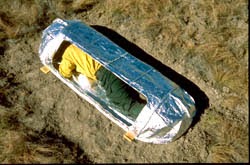
When the
shelter is packed into its carrying case, its dimensions are
approximately 21.59 cm x 13.97 cm x 10.16 cm. The New-Generation fire
shelter was developed in 2002 to replace the old style fire shelter
which is shaped like a pup-tent and has a carrying case. Its dimensions
are smaller than that of the old-Generation shelter.
Although fire shelters might save lives in South Africa, we should bear in mind that voluntary fire fighters should at all times focus on safety and preventing entrapment, or a situation where escape from a fire is impossible. Take care out there when fighting veld and bush fires in South Africa!!
The first known use of a fire shelter was in 1804, when a boy was saved from a prairie fire when his mother covered him with a fresh bison hide. Clark noted in his journal that the fire did not burn the grass around the boy.
- SAWXREP + MSBWX
The main reason for these deaths appears to be the sudden change in wind direction whereby people get trapped and then engulfed by flames and smoke. The sudden change in wind direction is not a rare occurrence when fighting fires. I am not going to go into detail here but one should always have several escape routes when fighting fires. What happens if I am trapped and there is no way out?
In the US all fire fighters working to extinguish bush and veld fires are issued with a Fire Shelter. No bush or veld firefighter (farmers, farm workers, voluntary fire fighters) should be without a personal fire shelter! I am the opinion that a Fire Shelter must be mandatory equipment for every person fighting a veld fire even for families that live in areas where veld fires are a frequent occurance. In an emergency situation, the fire shelter could save a life. The new-generation fire shelter provides increased protection from radiant and convective heat in bush and veld firefighter entrapment situations.
It must be clearly understood that a fire shelter is safety device of last resort and that general safety when fighting fires are of the utmost priority.
Protection of human life, both firefighters and civilians, is first priority. When arriving on a scene a fire crew must establish a safety zone(s), escape routes, verify communication is in place and designate lookouts. This allows the firefighters to engage a fire with options for a retreat should their current situation become unsafe. Although other safety zones should be designated, areas already burned generally provide a safe refuge from fire provided they have cooled sufficiently, are accessible, and have burned enough fuels so as to not reignite. Briefings must be done to inform new fire resources of hazards and other pertinent information.
Great emphasis is placed on safety and preventing entrapment, or a situation where escape from the fire is impossible. Prevention of this situation is reinforced with a list of watch out situations for firefighters to be aware of, which warn of potentially dangerous situations. South Africans fighting veld fires should in future carry a fire shelter as a last resort. In this inescapable situation, the shelter will provide limited protection from radiant and convective heat, as well as superheated air.
A fire shelter is a safety device of last resort used by bush and veld firefighters when trapped by wildfires. It is designed to reflect radiant heat, protect against convective heat, and trap breathable air (most firefighters deaths are from inhaling hot gases) in an attempt to save the firefighter's life.
Fire shelters are constructed layers of aluminum foil, woven silica, and fiberglass. When deployed, its maximum dimensions are approximately 218.44 cm x 39.37 cm x 78.74 cm and is shaped like a mound.
When the
shelter is packed into its carrying case, its dimensions are
approximately 21.59 cm x 13.97 cm x 10.16 cm. The New-Generation fire
shelter was developed in 2002 to replace the old style fire shelter
which is shaped like a pup-tent and has a carrying case. Its dimensions
are smaller than that of the old-Generation shelter.Although fire shelters might save lives in South Africa, we should bear in mind that voluntary fire fighters should at all times focus on safety and preventing entrapment, or a situation where escape from a fire is impossible. Take care out there when fighting veld and bush fires in South Africa!!
The first known use of a fire shelter was in 1804, when a boy was saved from a prairie fire when his mother covered him with a fresh bison hide. Clark noted in his journal that the fire did not burn the grass around the boy.
- SAWXREP + MSBWX
Labels:
Fires,
Mossel Bay Weather Blog,
SAWXREP,
Veld-Fires
Wednesday, 14 May 2014
Be part of the SA Weather Reports to keep your local community informed of approaching Severe Weather and possible Disasters.
The
effects of severe weather are felt every year by many South Africans. To
obtain real time weather information, the @SAWXREP was established 1 April 2014 on Twitter. Volunteers (members of the public, radio amateurs and the Media)
help keep their local communities safe and informed by providing timely
and accurate reports, images, photos and real time observation
information of severe weather or disasters to SAWXREP. The public
is requested to provide vital real time weather observations in their
area. SAWXREP is a non-profit organization that renders a FREE
COMMUNITY-BASED SERVICE.
Die uitwerking van gure weer word
jaarliks deur baie Suid Afrikaners beleef. Ten einde intydse
weerwaarnemings inligting te bekom vanaf die publiek het die @SAWXREP via Twitter tot
stand gekom op die 1 April 2014 via Twitter. Vrywilligers (lede van die publiek, radio amateurs en die
media) voorsien SAWXREP van intydse weerwaarnemings ten einde hul
plaaslike gemeenskap op hoogte te hou van gure weerstoestande dmv fotos,
beelde, rapporte en inligting. Die publiek word versoek om SAWXREP te
voorsien van weerwaarnemings in hul area. SAWXREP is 'n nie
winsgewende organisasie wat 'n gratis gemeenskapsdiens lewer.
A Service by the Public for the Public.
'n Diens deur die Publiek vir die Publiek
Subscribe to:
Posts (Atom)


